
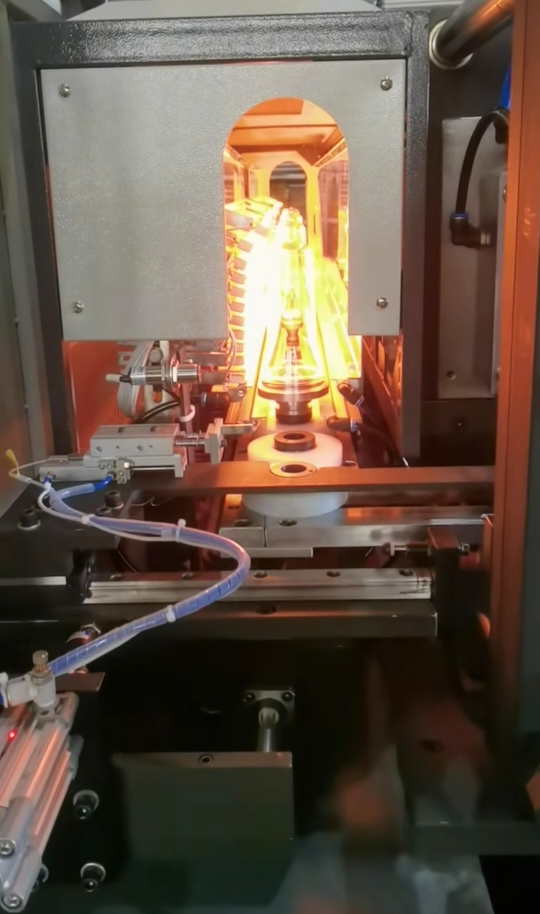
On a blow molding line, the heating tunnel is where the preform finally delivers on its promise and turns into a bottle. When the preform wall doesn’t hit the right temperature profile, you see it right away—haze, stress marks, thickness drift. You feel it in the scrap rate, in how long changeover drags, and in the heat you can pick up from ten feet away. That’s why the Husky hot runner IR heater element matters. Not as some generic heat source, but as a matched component built to live inside the Husky stretch blow molding platform. On these machines, the thermal behavior of the preform is the first hard constraint in the process window.
What matters, technically
Husky hot runner IR heater elements lean on short-wave infrared technology—quartz envelopes with high-purity tungsten filaments. That architecture gives you fast response: the element jumps to set temperature quickly, and you can keep a tight grip on the heating curve. In practice, the preform surface heats fast while the interior still needs time to soak, so you can manage the temperature gradient across the wall. The spec points that decide whether it fits and performs in the real world:
- Wattage and voltage: The element has to match the machine’s power budget and the heater block’s thermal load. If the wattage is off, the PID loop starts overshooting. You end up scorching the preform neck or leaving cold spots on the shoulder.
- Geometry and mounting: Length, diameter, and the flange interface are tolerance-critical. The element has to sit square in the heater block so the gap is consistent. If it doesn’t, the heat field shifts and the preform heats unevenly.
- Connector and termination: Husky machines commonly use specific high-temperature connector styles and terminal arrangements. Get this wrong and you add resistance, cook the termination, and invite early failure.
- Spectral output and thermal profile: Short-wave IR is high intensity, which works for PET because the material absorbs strongly in that range. But intensity alone isn’t enough. The element has to hold a stable temperature at the preform surface so the heating tunnel zones can be tuned predictably. At the end of the day, you’re buying repeatability. When the element matches the OEM’s intent, the temperature curve across the preform becomes a stable variable—not another daily fight.
Why it works on a Husky blow molder
In Husky blow molders, the hot runner system is the gatekeeper between the injection-molded preform and the stretch blow station. The IR heater element’s job is to keep the preform at the right temperature at the right time, with minimal drift. When the element matches the machine’s power and thermal design, you get:
- Stable preform heating: The preform heats with a controlled temperature gradient, so stretch behavior stays consistent. That shows up as better bottle geometry, fewer stress marks, and tighter wall thickness control.
- Tighter thermal control in the tunnel: With predictable element response, zone temperatures settle faster after startup and after changeover. Less time chasing temperature means more time making good bottles.
- Lower energy draw per part: Short-wave IR heats on demand, and when the element is correctly sized, the heater block doesn’t run hotter than it needs to. You see it in kWh per thousand bottles, and in a noticeably cooler machine environment.
- Longer service life in real conditions: Quartz elements are sensitive to thermal shock and poor seating. When the element is dimensionally correct and the termination is clean, you cut down hot spots, reduce stress on the quartz, and stretch the run time between replacements. Out on the plant floor, that looks like fewer alarms, fewer scrap piles, and fewer late-night callouts to chase a heater that won’t hold setpoint.
The things you learn the hard way
A matched Husky hot runner IR heater element isn’t a plug-and-play commodity if you treat it like one. Installation and operating details decide whether you get the performance the specs promise.
- Compatibility is exact, not “close enough”: The element has to match the OEM’s wattage, voltage, dimensions, and termination. “Close enough” buys you unstable heating, higher failure rates, and sometimes damage to the heater block or the electrical interface.
- Seating and alignment matter more than people think: Even a small gap between the element and the heater block changes heat transfer. Install it square, verify contact, and make sure there’s no binding or uneven pressure that can crack the quartz.
- Thermal shock is the enemy: If the heater has been off and you slam it to full power, the quartz and filament take a stress hit. Bring the element up gradually to setpoint, especially after a cold start.
- Keep the termination clean and dry: High-temperature connections pick up dust, oil, and oxidation. A contaminated termination runs hotter and dies sooner. Inspect, clean, and re-torque per the maintenance schedule.
- Monitor the whole system, not just the heater: If preform heating starts drifting, check the element—but also check reflector condition, zone airflow, and the heater block’s mechanical condition. The thermal field is a system, and the element is one piece. We design the Husky hot runner IR heater element to match the machine’s thermal and electrical intent. Run it with discipline, and it pays you back with the one thing a blow molding line can’t do without: predictable heat, repeat after repeat.